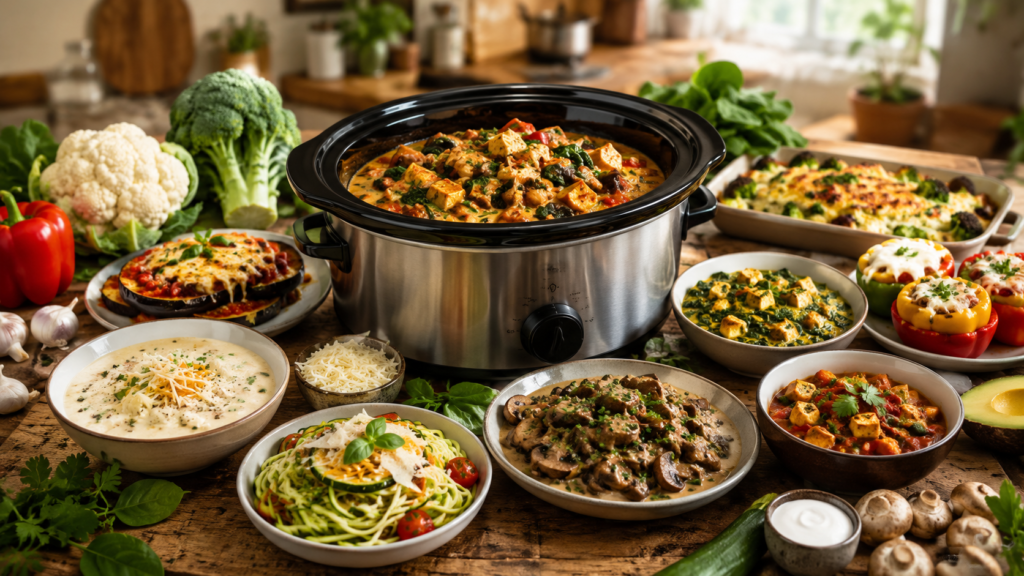
Slow cooker vegetarian keto recipes combine low-carb vegetables with meat-free proteins such as tofu, tempeh, eggs, cheese, seitan and carefully selected plant-based mince. The most reliable options include cauliflower curry, zucchini lasagna, vegetarian chili, broccoli cheese soup, mushroom stroganoff and tofu-based stews.
Vegetarian slow-cooker cooking and ketogenic eating do not always fit together automatically. Many traditional vegetarian Crockpot recipes depend on potatoes, beans, lentils, pasta, rice or sweetened sauces. Conversely, many keto slow-cooker meals rely heavily on beef, poultry or pork. A successful meat-free keto recipe must therefore control carbohydrates while still providing satisfying texture, protein and flavor.
Ketogenic diets generally restrict carbohydrates substantially, often to approximately 20–50 grams per day, although the appropriate intake depends on the individual and the purpose of the diet. This guide does not prescribe a daily carbohydrate target. Instead, it helps readers at ketoslowcookerrecipes.com choose meals that can fit into a personally appropriate vegetarian keto plan.
Which Vegetarian Keto Slow Cooker Recipe Fits Your Needs?
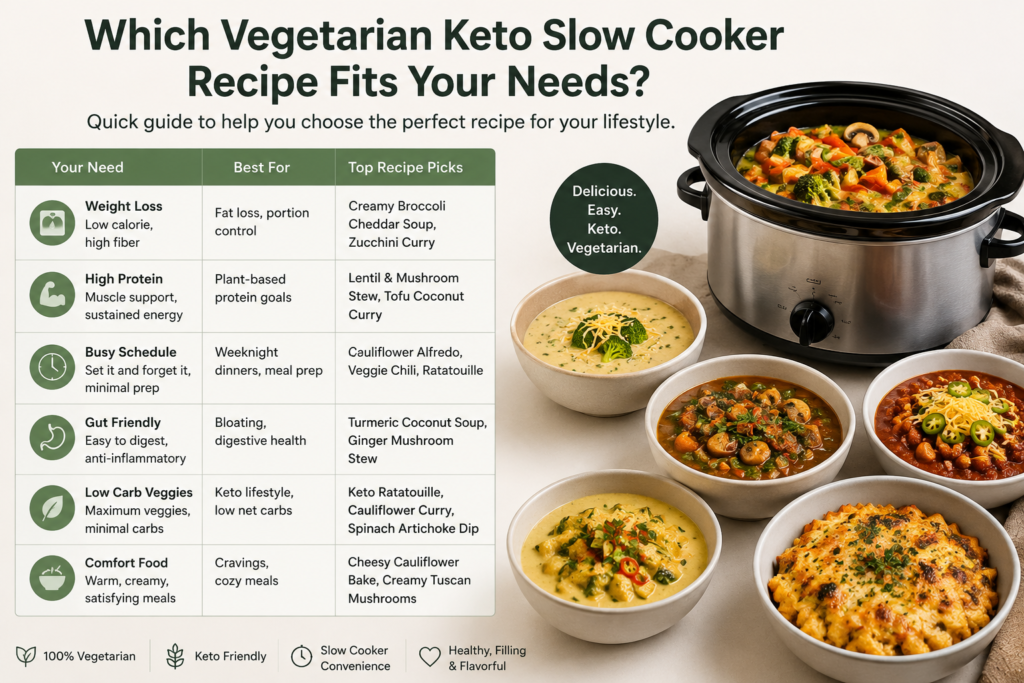
The right recipe depends on more than flavor. Check its primary protein, dietary classification, cooking time, storage performance and potential carbohydrate sources before choosing it. A coconut tofu curry may suit a vegan reader, while broccoli cheddar soup may be easier for someone avoiding soy. Chili and tomato-based casseroles usually freeze more predictably than egg or cream-heavy dishes.
Use this comparison as an initial selection tool. Final net-carbohydrate and protein figures should be calculated from the exact ingredient brands, quantities and serving yield used in each complete recipe.
| Recipe | Main protein | Dietary fit | Best use | Cooking range | Freezer fit |
| Cauliflower tikka masala | Tofu | Vegan option | Meal prep | 3–5 hours | Strong |
| Mushroom stroganoff | Seitan or tofu | Dairy-free option | Comfort dinner | 3–4 hours | Moderate |
| Zucchini lasagna | Ricotta and eggs | Soy-free | Family dinner | 2½–4 hours | Strong |
| Broccoli cheddar soup | Cheese | Soy-free | Quick comfort meal | 2–3 hours | Moderate |
| Tempeh coconut curry | Tempeh | Vegan | High-protein dinner | 3–5 hours | Strong |
| Vegetarian keto chili | Tofu or plant mince | Vegan option | Batch cooking | 4–6 hours | Strong |
| Broccoli quiche | Eggs and cottage cheese | Soy-free | Breakfast prep | 2–3 hours | Limited |
Choose according to your main priority:
- For freezing: chili, curry, cabbage soup or lasagna
- For vegan meals: tofu curry, tempeh curry or vegetable stew
- For soy-free meals: quiche, cheese soup or eggplant Parmesan
- For higher protein: tempeh curry, tofu chili or seitan stroganoff
- For families: lasagna, chili or broccoli cheddar soup
What Makes a Slow Cooker Recipe Vegetarian and Keto?
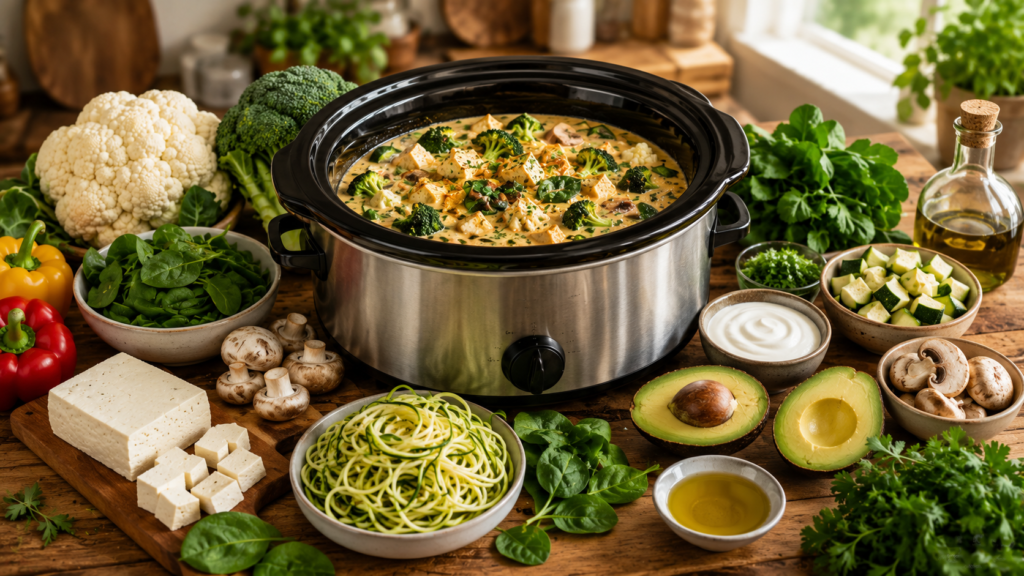
A slow-cooker recipe is vegetarian and keto when it excludes meat and fish, uses a meaningful meat-free protein source, and limits ingredients that contribute excessive digestible carbohydrates. A recipe being vegetarian does not make it low carb, while a recipe being meatless does not guarantee that it provides enough protein for a complete meal.
The first requirement is vegetarian compliance. Lacto-ovo vegetarians may eat eggs, cheese, yogurt and other dairy foods, while vegans exclude all animal-derived ingredients. This distinction matters because eggs and dairy are among the easiest low-carb vegetarian protein sources. Vegan keto recipes normally rely more heavily on tofu, tempeh, seeds, nuts, lupini products and suitable plant-based protein products.
The second requirement is carbohydrate control. Recipe calculations should include vegetables, sauces, dairy products, nuts, seasonings and meat substitutes—not just obvious starches. Product formulations also vary internationally, so nutrition should be calculated using the exact brands and serving sizes used.
A balanced recipe should include:
- A clear protein source rather than vegetables alone
- Non-starchy vegetables for volume, fiber and texture
- Enough fat to create flavor and satiety
- A controlled amount of tomato, onion and other moderate-carb ingredients
- Unsweetened sauces, milks and condiments
- Defined serving sizes for meaningful nutrition calculations
- Vegetarian, vegan and allergen labels where relevant
- A texture plan for vegetables that release water
A carefully planned vegetarian diet can provide adequate nutrition, but attention may be needed for protein variety, iron, vitamin B12 and other nutrients. Vegan diets require particular care because natural food sources of vitamin B12 are limited.
How Should Net Carbs and Protein Be Calculated?
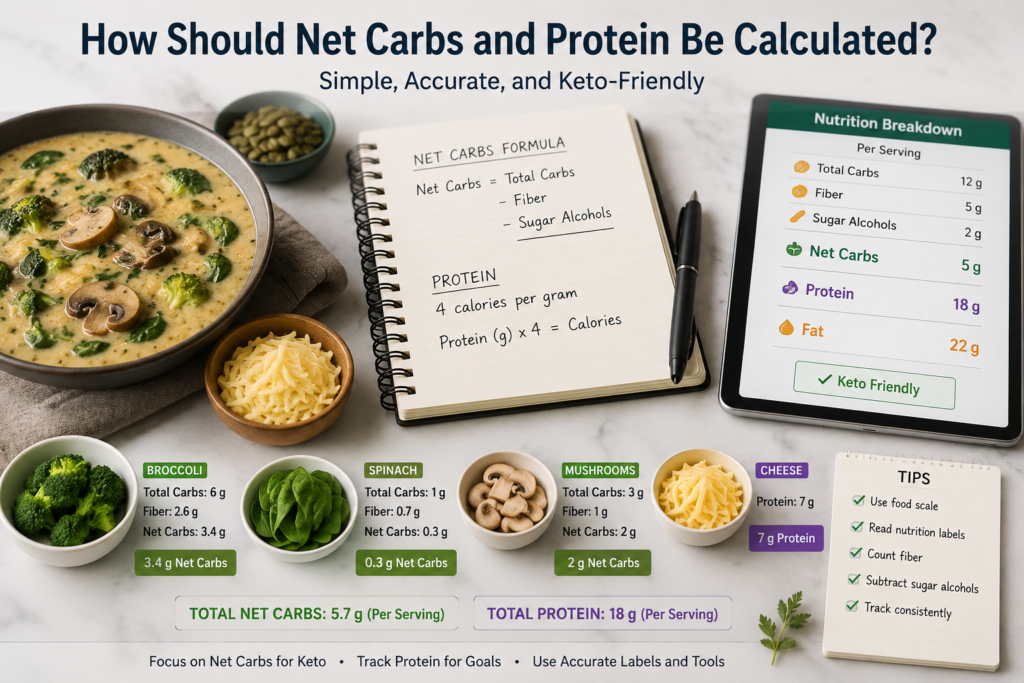
Nutrition figures are only useful when they are based on a defined recipe yield. Calculate the carbohydrates, fiber, protein and calories from every ingredient, including vegetables, sauces, dairy products, nuts, seeds and packaged meat substitutes. Divide the final totals by the actual number of servings rather than an assumed portion count.
International labels require extra care. In the United States and Canada, fiber is commonly included within total carbohydrates and may be subtracted when calculating net carbohydrates. In several other countries, the carbohydrate figure may already exclude fiber. Subtracting fiber again can therefore create an inaccurate result.
Use the following publishing method:
- Weigh or measure every ingredient before cooking
- Record the exact product used for sauces and meat substitutes
- Include onions, tomatoes, nuts and dairy in the calculation
- Define the number or weight of finished servings
- Calculate values before adding optional toppings
- List toppings separately when they change the totals
- Recalculate whenever ingredient quantities change
- Label figures as estimates unless laboratory analysis is available
Add a short note beneath every recipe:
Nutrition values are estimates based on the listed ingredients and serving yield. Product formulations vary by brand and country, so calculate the recipe with your own ingredients when precise carbohydrate control is required.
This methodology increases trust because it explains where the numbers come from rather than presenting unsupported values.
Which Ingredients Work Best in Vegetarian Keto Slow Cooker Meals?
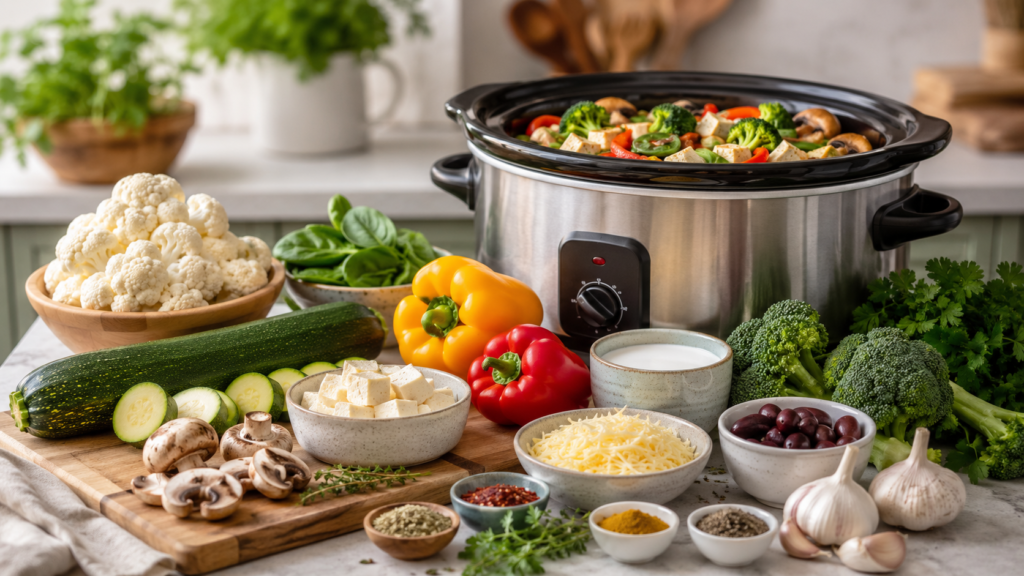
The best ingredients perform a specific role: vegetables create volume, protein makes the dish substantial, fats carry flavor, and low-carb thickeners control the final consistency. Choosing ingredients by function produces better results than simply placing several low-carb foods in the cooker.
Firm vegetables such as cauliflower, cabbage, broccoli stems, eggplant and green beans tolerate longer cooking better than delicate vegetables. Mushrooms, zucchini and spinach are useful but release considerable moisture or soften quickly. They often need browning, draining or later addition.
Protein should be selected according to the recipe’s cooking time. Firm tofu and tempeh can withstand several hours in sauces. Eggs work in breakfast casseroles and crustless quiches. Paneer, halloumi, seitan and plant-based mince can add a firmer bite, although packaged products must be checked for starches, sugars and gluten.
Use ingredients from these groups:
- Low-carb vegetables: cauliflower, broccoli, mushrooms, cabbage, zucchini, spinach, kale, eggplant, peppers and green beans
- Vegetarian proteins: tofu, tempeh, eggs, paneer, cottage cheese, Greek yogurt, seitan and unsweetened plant-based mince
- Flavorful fats: olive oil, avocado oil, coconut milk, cream, butter, cheese, pesto, nuts and seeds
- Keto-compatible thickeners: cream cheese, puréed cauliflower, grated cheese, ground chia, ground flax and small amounts of xanthan gum
- Flavor builders: garlic, ginger, herbs, curry spices, mustard, olives, lemon zest, nutritional yeast and sugar-free chili sauce
Do not add every ingredient at the beginning. Cheese, cream, yogurt, spinach, fresh herbs and delicate vegetables usually perform better near the end. This staged approach maintains color, texture and a smoother sauce.
Can Moderate-Carb Ingredients Still Be Used?
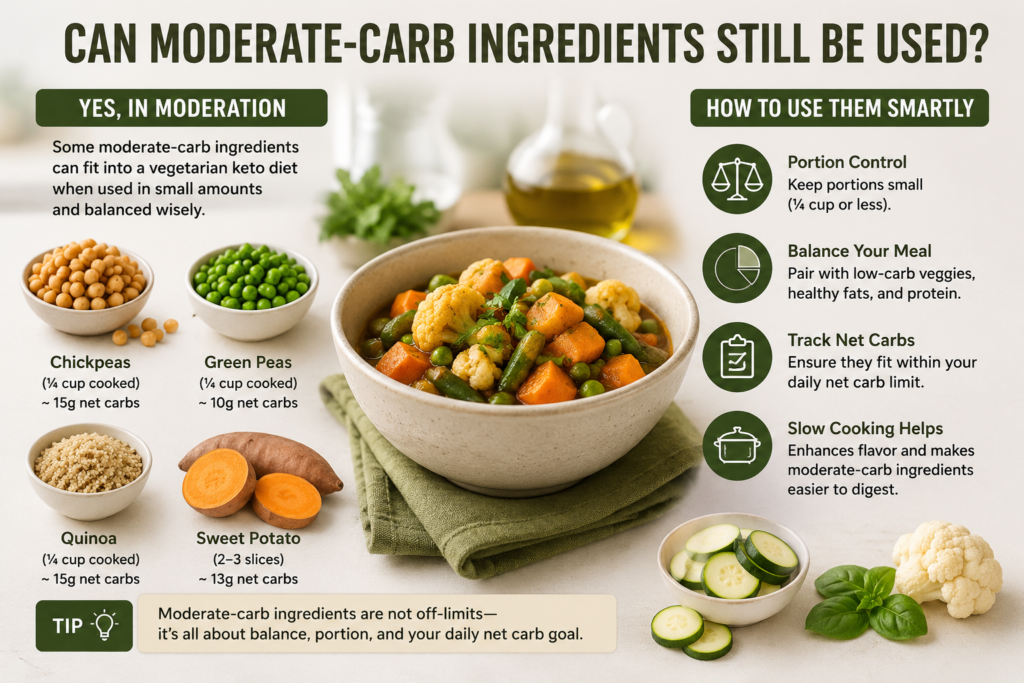
A vegetarian keto recipe does not need to eliminate every onion, tomato, carrot or artichoke. The more useful question is how much of the ingredient appears in each finished serving. Two tablespoons of tomato paste spread across eight portions affect the recipe differently from an entire jar of sweetened pasta sauce divided into four portions.
Use higher-carbohydrate ingredients as flavor components rather than as the main volume of the meal. Onion can provide depth when used in a controlled amount. Tomato can balance cream and spice, while a small quantity of carrot may round out a soup. The total recipe still needs to fit the intended carbohydrate range.
Apply these portion-control rules:
- Use tomato paste for concentrated flavor instead of excess sauce
- Compare unsweetened passata with prepared pasta sauce
- Reduce onion rather than removing it automatically
- Avoid combining several moderate-carb ingredients in large quantities
- Use mushrooms, cabbage or cauliflower to create additional volume
- Divide carbohydrate-rich garnishes across the full yield
- Calculate prepared sauces from their labeled serving size
- Treat nuts and seed butters as measured ingredients, not unlimited foods
This approach creates more flavorful recipes than blanket exclusion. It also makes the article more useful internationally because ingredient availability and personal carbohydrate targets vary.
Which Ingredients Can Push a Vegetarian Recipe Out of Keto Range?
The ingredients most likely to disrupt a vegetarian keto recipe are grains, starchy vegetables, conventional legumes, sweet sauces and flour-based thickeners. Some of these foods are nutritious in other dietary patterns, but their carbohydrate concentration can make it difficult to maintain a strict keto target.
Beans and lentils are common vegetarian protein sources, yet they also provide substantial carbohydrates. A small quantity may fit some moderate low-carb plans, but a bean-heavy chili is unlikely to suit someone following a strict ketogenic diet. Rice, pasta, barley, quinoa, corn and potatoes create the same problem because they often form the bulk of conventional slow-cooker recipes.
Less obvious sources also matter. Tomato sauce, onions, carrots, cashews, sweetened coconut milk, bottled curry sauce and vegetarian meat substitutes can add more carbohydrates than expected. The solution is not to remove every moderate-carb ingredient. It is to use deliberate portions and calculate the complete dish.
Check recipes for:
- Potatoes, sweet potatoes and other starchy roots
- Rice, pasta, barley, couscous and quinoa
- Large quantities of chickpeas, kidney beans or lentils
- Corn, peas and sweetened vegetable mixtures
- Flour, breadcrumbs, cornstarch and packaged gravy powder
- Honey, maple syrup, brown sugar and sweet chili sauce
- Sweetened plant milk or coconut milk
- Tomato sauces containing added sugar
- Plant-based burgers or mince containing starch fillers
- Large amounts of cashews or high-carb nut sauces
For international readers, ingredient labels may display carbohydrates differently. Use the nutrition format available in your country and avoid subtracting fiber twice. Most importantly, calculate the finished recipe according to its actual yield. A low-carb ingredient list can still produce a high-carb serving when the portion is too large.
How Should Common Ingredients Be Prepared?
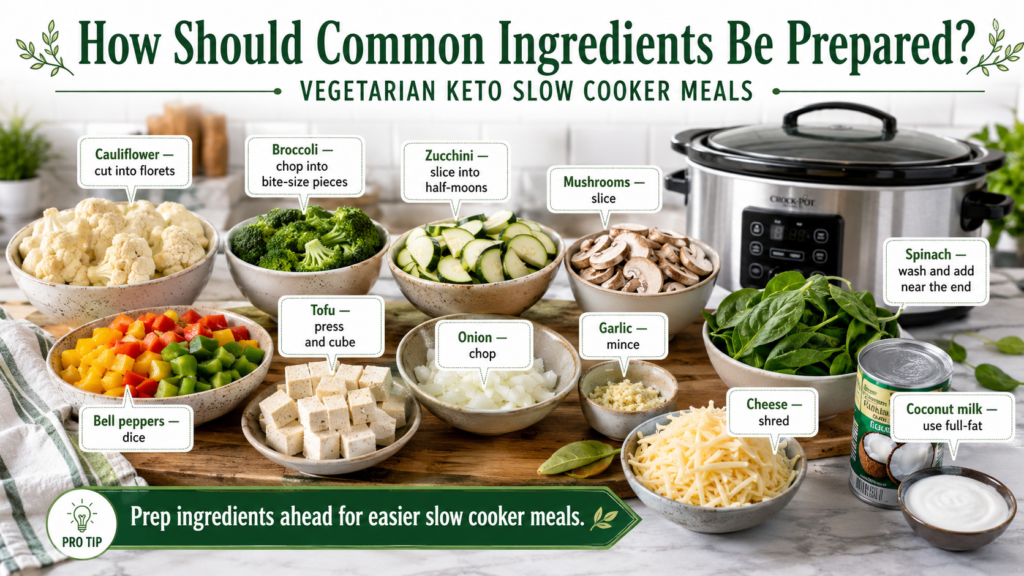
An ingredient can fit a vegetarian keto diet but still perform poorly in a slow cooker. Zucchini, mushrooms and spinach are low in carbohydrates, yet all three can release enough water to dilute a sauce. Cheese may provide protein and fat but can become grainy when cooked for too long. Ingredient suitability must therefore account for nutrition and cooking behavior.
Use this functional matrix when adapting recipes:
| Ingredient | Keto role | Best preparation | Best cooking stage |
| Extra-firm tofu | Protein | Press and cut into large cubes | Beginning or middle |
| Tempeh | Protein | Brown for deeper flavor | Beginning |
| Mushrooms | Volume and flavor | Brown until released liquid evaporates | Beginning |
| Zucchini | Low-carb vegetable | Salt, drain and cut thickly | Final 1–2 hours |
| Frozen spinach | Greens | Thaw and squeeze dry | Final 15–20 minutes |
| Cauliflower | Vegetable and thickener | Cut evenly or purée after cooking | Beginning |
| Cream cheese | Fat and thickener | Soften before stirring | Final 30 minutes |
| Shredded cheese | Protein and fat | Add gradually | Final 10–20 minutes |
| Fresh herbs | Aroma | Chop immediately before serving | After cooking |
| Avocado | Fat and garnish | Add fresh | After cooking |
The most reliable formula is:
- One defined vegetarian protein
- Two or three non-starchy vegetableOne concentrated flavor base
- One controlled fat source
- Minimal added liquid
- Delicate dairy or greens added near the end
Which Slow Cooker Vegetarian Keto Recipes Should You Make?
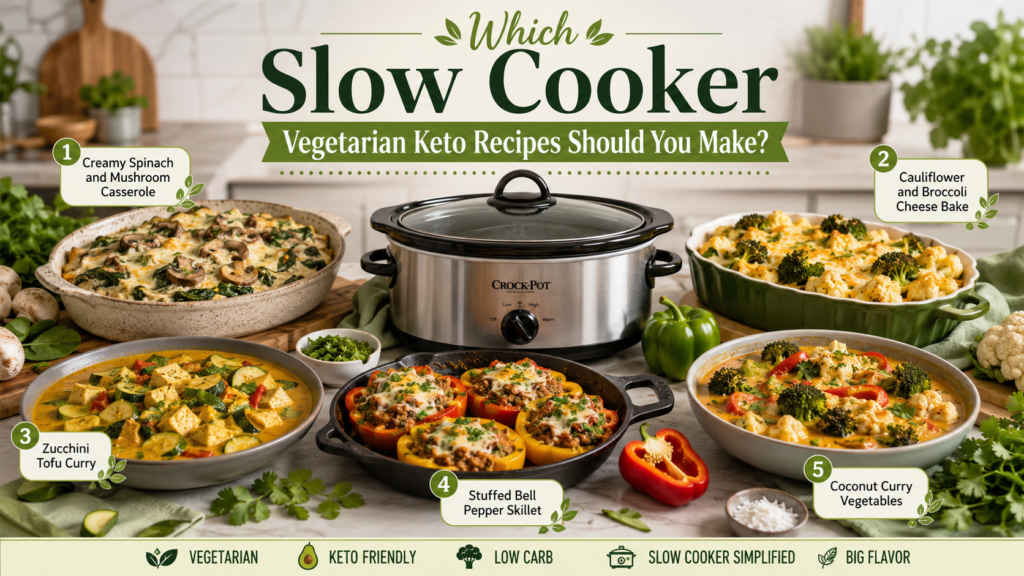
The best recipe depends on whether you want a vegan meal, a high-protein dinner, a creamy comfort dish or a freezer-friendly batch. The following 17 options use different protein sources and flavor profiles, making it easier to avoid a repetitive weekly menu.
- Cauliflower Tikka Masala: Combine cauliflower, firm tofu, coconut milk, tomato, ginger and garam masala. Add spinach near the end.
- Creamy Mushroom Stroganoff: Use browned mushrooms, seitan or tofu, vegetable stock, paprika, mustard and sour cream.
- Zucchini and Eggplant Lasagna: Layer drained vegetables with ricotta, mozzarella, Parmesan and low-sugar marinara.
- Broccoli Cheddar Soup: Slow-cook broccoli with stock and seasoning, then blend partially before adding cream cheese and cheddar.
- Tempeh Coconut Curry: Combine browned tempeh, cauliflower, curry paste, coconut milk and green vegetables.
- Vegetarian Keto Chili: Use mushrooms, low-carb plant mince, peppers, tomatoes, spices and cauliflower rice.
- Spinach Artichoke Casserole: Mix spinach, artichoke hearts, cream cheese, mozzarella, garlic and Parmesan.
- Buffalo Cauliflower and Tofu: Cook cauliflower and firm tofu with unsweetened hot sauce, seasoning and butter.
- Cabbage Roll Soup: Replace rice with cauliflower rice and meat with tofu crumble or suitable vegetarian mince.
- Three-Cheese Spaghetti Squash: Combine cooked squash strands with ricotta, mozzarella, Parmesan and Italian herbs.
- Thai Peanut Tofu Curry: Use tofu, coconut milk, natural peanut butter, zucchini and sugar-free curry paste.
- Eggplant Parmesan Casserole: Layer prepared eggplant with marinara, mozzarella, Parmesan and herbs.
- Jalapeño Popper Cauliflower Soup: Blend cauliflower with jalapeño, cream cheese, cheddar and smoked paprika.
- Mediterranean Artichoke Stew: Combine artichokes, zucchini, olives, spinach, tomato, herbs and feta.
- Crustless Broccoli Quiche: Cook eggs, broccoli, cottage cheese, cheddar and seasoning in a lined cooker.
- Creamy Tuscan Tofu: Pair firm tofu with spinach, a controlled amount of sun-dried tomato, cream and herbs.
Vegan Keto Vegetable Stew: Slow-cook tofu, mushrooms, cabbage, cauliflower and zucchini in a strongly seasoned broth.
How Should You Use These 17 Recipe Ideas?
The following dishes are starting points for complete vegetarian keto recipes. Each one should eventually link to a dedicated recipe page containing exact quantities, tested cooking times, yield, nutrition estimates, storage instructions and a printable recipe card. Until those full pages are available, avoid presenting the short descriptions as fully tested recipes.
Every recipe entry should display the same decision data so readers can compare meals without opening several pages. Add this compact block beneath each recipe description:
- Yield: [verified number of servings]
- Slow-cooker size: [tested cooker capacity]
- Preparation time: [verified time]
- Cook on low: [tested range]
- Cook on high: [tested range, when suitable]
- Main protein: [tofu, tempeh, eggs, dairy or seitan]
- Estimated net carbs: [calculated amount per serving]
- Estimated protein: [calculated amount per serving]
- Dietary fit: [vegetarian, vegan option, soy-free or gluten-free]
- Freezing suitability: [strong, moderate or not recommended]
- Key texture step: [drain, brown, press or add late]
Do not publish invented nutrition or testing claims. Replace every bracketed field after the recipe has been finalized and evaluated.
For stronger information gain, rename the recipes so each title explains its low-carb technique:
How Were These Recipes Selected and Evaluated?
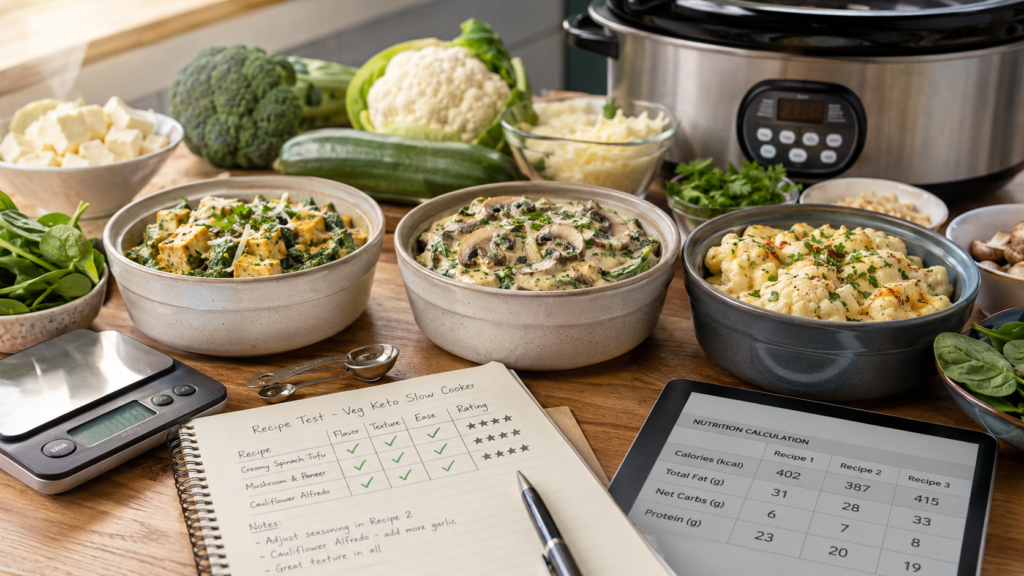
Each recipe concept was selected because it can combine a vegetarian protein with low-carbohydrate vegetables in a cooking format suited to a slow cooker. The evaluation also considers whether the meal can remain satisfying without meat, beans, grains, potatoes or flour-based thickeners.
At publication, distinguish clearly between recipes that have been physically tested and recipes that are editorially developed concepts. Testing should record more than whether the dish was edible. It should evaluate the cooking time, vegetable texture, sauce consistency, protein structure, reheating quality and suitability for freezing.
Evaluate each recipe against these criteria:
- A recognizable vegetarian protein source
- A realistic low-carbohydrate serving
- Ingredients that tolerate slow cooking
- A clear strategy for excess vegetable moisture
- Accessible ingredient substitutions
- Defined cooker capacity and fill level
- High and low settings when both are appropriate
- Texture immediately after cooking
- Texture after refrigeration and reheating
- Freezing performance where applicable
- Dietary modifications for dairy, soy, gluten or eggs
Use one of these transparency statements:
For untested concepts: This recipe concept has been editorially evaluated for ingredient compatibility but has not yet completed physical kitchen testing.
For tested recipes: This recipe was prepared in a [capacity] slow cooker and evaluated for cooking time, sauce consistency, vegetable texture and reheating quality.
Do not use the second statement until the test has genuinely been completed.
How Do You Prevent Watery Vegetarian Slow Cooker Meals?
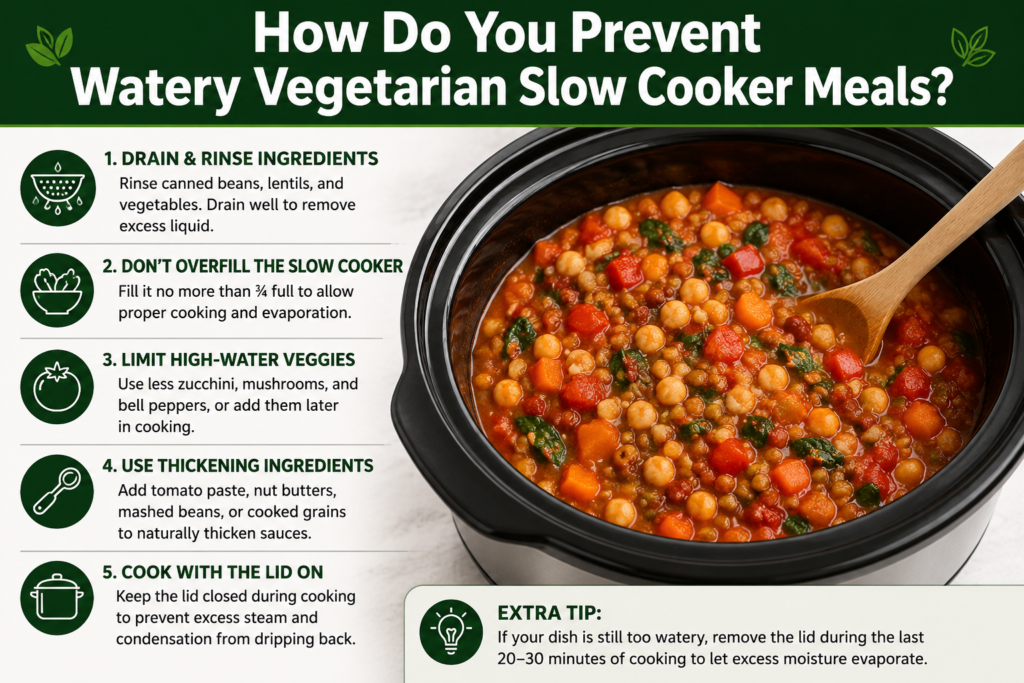
Vegetarian slow-cooker meals become watery when vegetables release more moisture than the recipe can absorb or evaporate. Because a slow cooker holds steam beneath its lid, a recipe usually needs less stock than the equivalent stovetop dish.
Zucchini, mushrooms, spinach, cabbage and frozen vegetables are common sources of unexpected liquid. Salt and drain sliced zucchini or eggplant before layering them in casseroles. Brown mushrooms in a skillet until their released liquid evaporates. Thaw and drain frozen spinach instead of adding an icy block directly to a creamy sauce.
Stock should be measured conservatively. Begin with enough liquid to support cooking but not enough to submerge every vegetable. It is easier to add a little hot stock near the end than to rescue a thin, diluted sauce.
How Does the Vegetarian Keto Slow Cooker Fit Score Work?
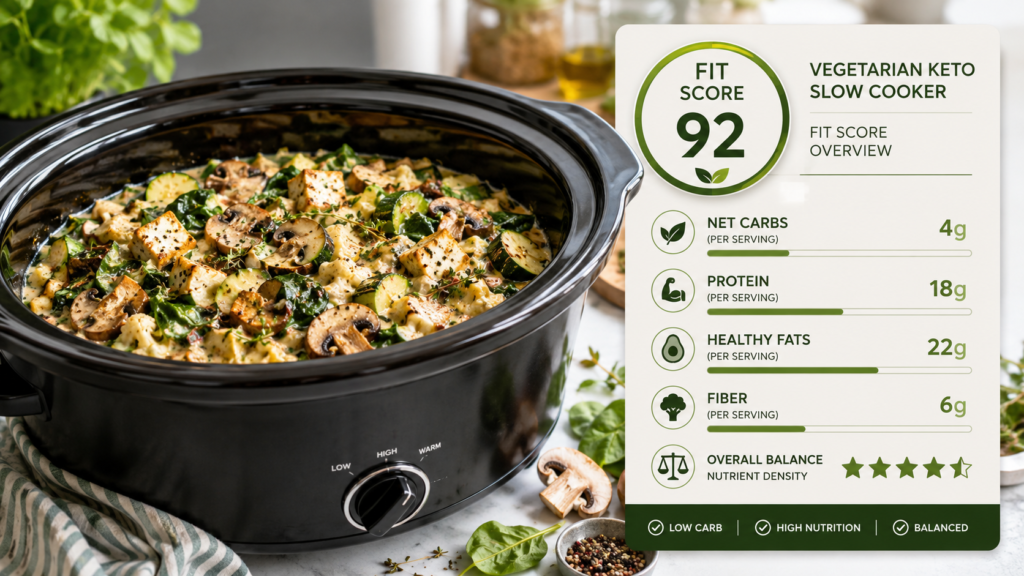
The Vegetarian Keto Slow Cooker Fit Score helps readers compare recipes using more than carbohydrate content alone. A meal can be low in carbohydrates but still perform poorly if it lacks protein, becomes watery or reheats badly. Each recipe receives zero, one or two points across five practical criteria.
The maximum score is 10. The score is a recipe-selection tool, not a medical judgment or a guarantee that the meal fits every individual carbohydrate target.
Score each recipe as follows:
- Net-carb suitability: 0 for difficult to fit, 1 for portion-dependent, 2 for strongly compatible
- Protein adequacy: 0 for minimal protein, 1 for moderate protein, 2 for a clearly substantial source
- Slow-cooker texture: 0 for unstable, 1 for acceptable with intervention, 2 for consistently suitable
- Meal-prep performance: 0 for poor storage, 1 for refrigeration only, 2 for good refrigeration and freezing
- Dietary flexibility: 0 for difficult to modify, 1 for one practical variation, 2 for several workable variations
Interpret the result:
- 9–10: Excellent main-meal candidate
- 7–8: Strong recipe with one limitation
- 5–6: Suitable for selected readers or occasional use
- Below 5: Better as a side dish or supporting recipe
Display the score beside the nutrition and cooker data for every complete recipe. Add a one-sentence explanation so readers understand why points were lost.
Use these moisture-control methods:
- Salt sliced zucchini and eggplant, then blot them dry
- Brown mushrooms before adding them
- Drain thawed frozen vegetables thoroughly
- Add fresh spinach during the final 10–20 minutes
- Use thick coconut milk rather than a diluted beverage
- Avoid repeatedly opening the lid during cooking
- Purée part of a cauliflower-based soup
- Stir in cream cheese or grated cheese near the end
- Use ground chia or xanthan gum in very small amounts
- Reduce excess liquid separately when necessary
- Avoid filling the slow cooker beyond its recommended capacity
Do not add a large amount of thickener before assessing the finished consistency. Chia, flax and xanthan continue absorbing liquid after addition. Start with a minimal quantity, wait, and reassess.
What Should Be Recorded During Moisture Testing?
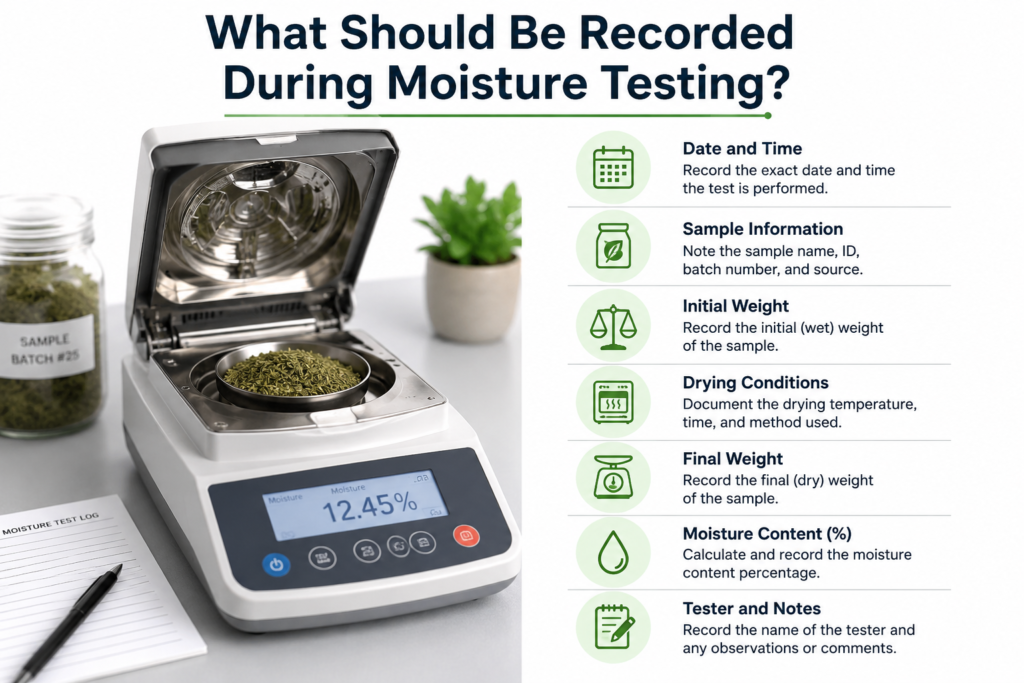
Moisture testing should compare preparation methods under the same cooking conditions. For example, one batch can use raw mushrooms while another uses mushrooms browned until their released liquid evaporates. The vegetable weight, sauce quantity, cooker size and cooking time should remain consistent so the result is meaningful.
Record the appearance and consistency immediately after cooking and again after the meal rests for 10 minutes. A sauce that initially appears thin may thicken as cheese, chia or puréed cauliflower absorbs moisture.
Use this test framework:
| Ingredient | Method A | Method B | Record after cooking |
| Zucchini | Added raw at start | Salted, drained and added late | Liquid level and firmness |
| Mushrooms | Added raw | Browned before cooking | Sauce dilution and flavor |
| Frozen spinach | Added frozen | Thawed and squeezed dry | Water release and color |
| Eggplant | Added raw | Salted and blotted | Shape and sauce thickness |
| Cauliflower | Large florets | Small florets | Texture at equal cook time |
Report only genuine observations. Useful notes include:
- Total liquid added at the start
- Finished sauce thickness
- Vegetable firmness
- Whether the lid was opened
- Whether the meal thickened while resting
- Whether reheating released additional water
This creates original cooking evidence that generic roundup articles usually lack.
When Should Tofu, Dairy and Vegetables Be Added?
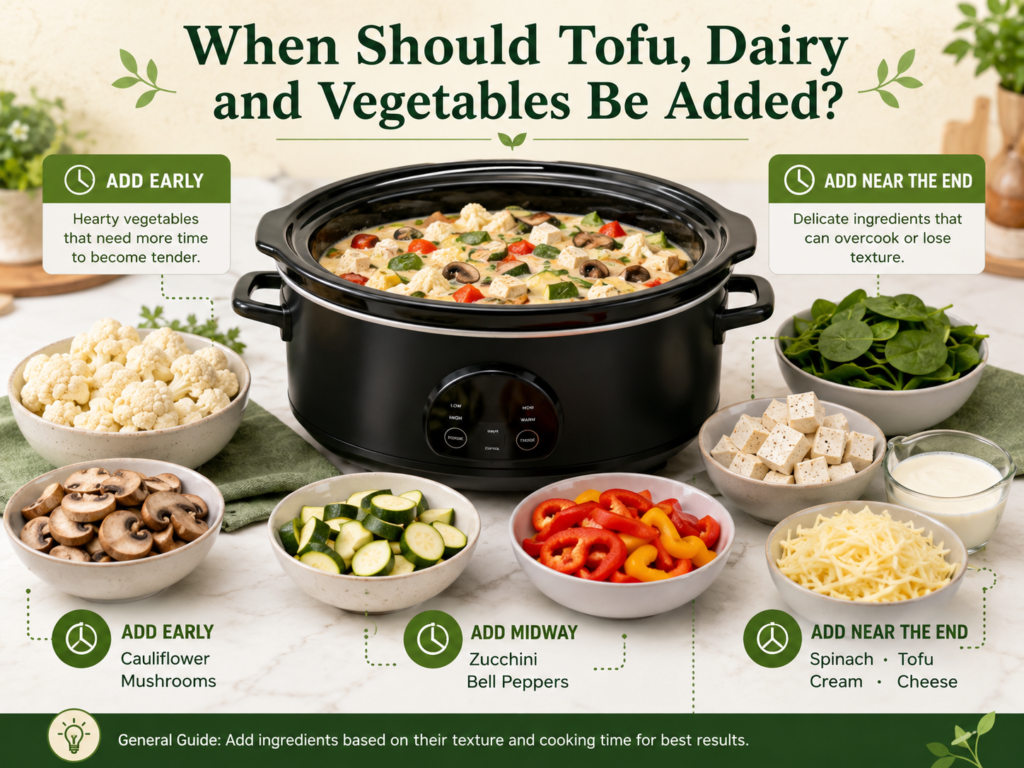
Ingredients should be added according to how quickly they soften, separate or absorb flavor. Firm ingredients can usually cook from the beginning, while dairy products, leafy greens, fresh herbs and tender vegetables perform better during the final stage.
Firm tofu can remain intact during several hours of slow cooking when it is pressed and cut into large cubes. Smaller cubes may crumble, which is useful for chili but less suitable for curry. Tempeh can be added early, although browning it first improves flavor. Seitan absorbs sauce effectively but may become overly soft when cooked for too long.
Cream, sour cream, yogurt and cheese can split or become grainy after prolonged exposure to heat and acidic tomato sauces. Stir them in after the vegetables are tender, then cook only until the sauce is hot and cohesive.
A practical timing guide is:
- Beginning: cabbage, cauliflower, eggplant, firm tofu, tempeh, onions, peppers and dried spices
- Middle: broccoli florets, seitan, green beans, zucchini and prepared plant-based mince
- Final 30–45 minutes: cream cheese, coconut cream, artichokes and tender vegetable pieces
- Final 10–20 minutes: spinach, kale, shredded cheese, heavy cream and fresh chilies
- After cooking: yogurt, avocado, fresh herbs, lemon juice, nuts and seeds
Egg casseroles require additional care. Use a cooker suitable for the recipe, avoid relying on appearance alone and check the center with a food thermometer. USDA guidance recommends verifying doneness with temperature rather than color or texture, particularly for egg dishes.
Correct timing is not merely a cosmetic detail. It controls whether the finished dish has distinct vegetables, intact protein and a smooth sauce instead of a homogeneous, overcooked texture.
What Size Slow Cooker Should You Use?
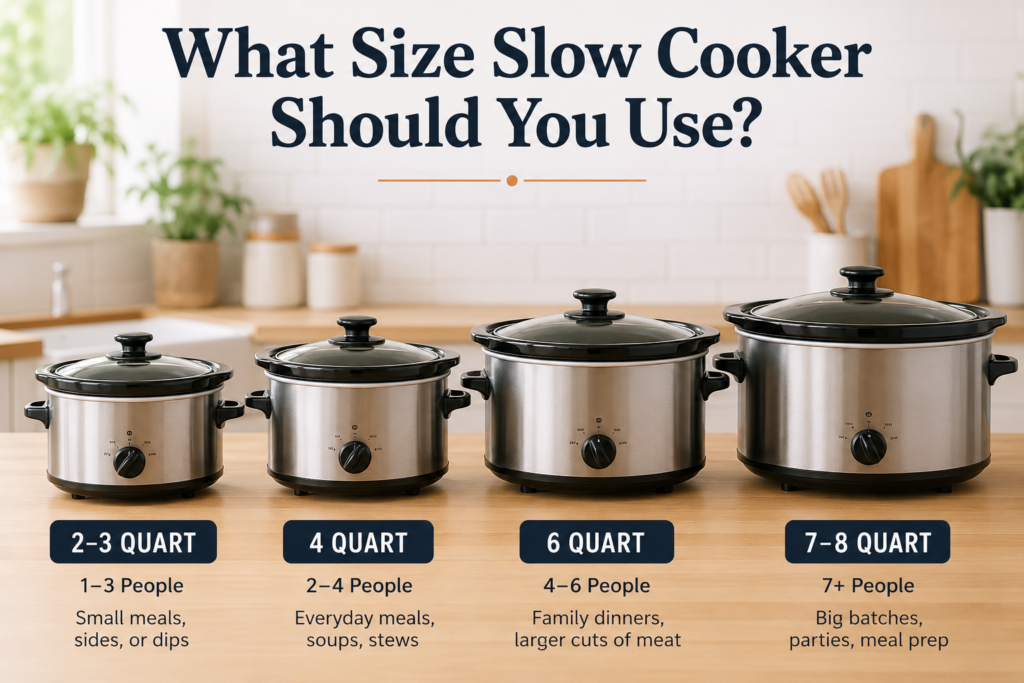
Cooker capacity affects depth, evaporation, heating time and final texture. A recipe developed in a 4-quart cooker may become shallower and thinner in an 8-quart model. Conversely, placing a large batch into a small cooker can restrict circulation and lead to uneven cooking.
Follow the fill recommendations supplied by the appliance manufacturer. Do not assume that one cooking time applies equally to every model, shape or capacity.
| Cooker size | Practical use | Typical recipe type | Main concern |
| 3 quart | Small households | Dips, soups and small casseroles | Easy to overfill |
| 4 quart | Standard vegetarian meals | Curry, quiche and lasagna | Limited batch capacity |
| 5–6 quart | Family and meal prep | Chili, soup and large casseroles | May thin small recipes |
| 7–8 quart | Large households | Doubled recipes and batch cooking | Poor results when underfilled |
When adapting a recipe:
- Keep the ingredient depth reasonably similar
- Increase seasoning and thickener cautiously when doubling
- Do not automatically double cooking time
- Check tender vegetables earlier in a larger batch
- Use a liner only when approved for the appliance and recipe
- Record the model and capacity during recipe testing
- State whether the cooker is round or oval when shape affects layering
This information is especially important for zucchini lasagna, quiche and layered casseroles.
How Can You Add More Protein Without Adding Meat?
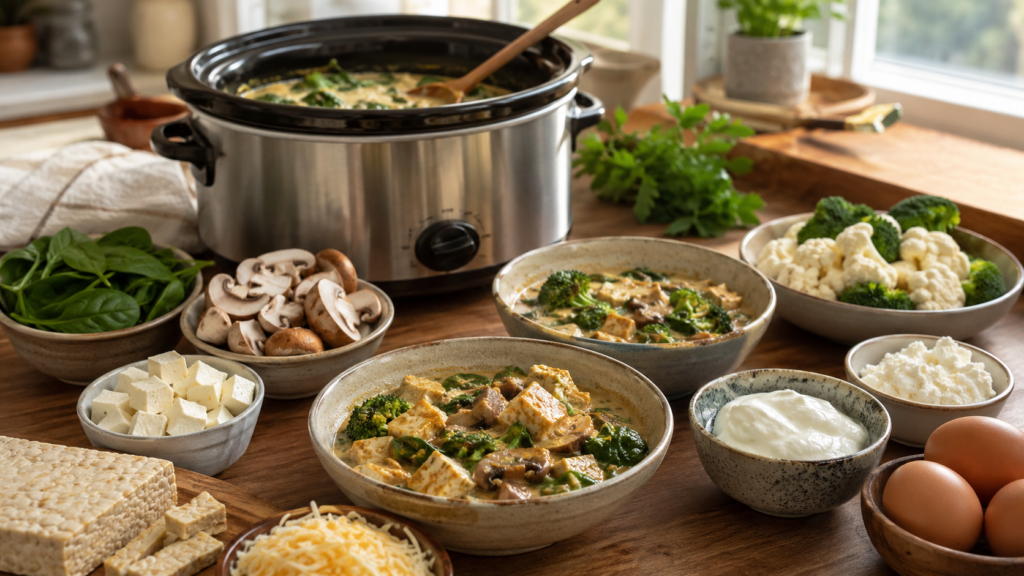
A vegetarian keto dinner needs more than a mixture of vegetables and fat. Protein improves meal structure, supports fullness and helps distinguish a complete dinner from a vegetable side dish. The best protein choice depends on whether the recipe permits eggs, dairy, soy or gluten.
Tofu is one of the most versatile options because it absorbs curries, tomato sauces and aromatic broths. Tempeh provides a firmer texture and stronger flavor. Eggs work particularly well in breakfast casseroles, crustless quiches and vegetable bakes. Cottage cheese, Greek yogurt, paneer and hard cheese provide additional options for lacto-ovo vegetarians.
Seitan is high in protein but unsuitable for people avoiding gluten. Packaged meat substitutes may be convenient, although some contain breadcrumbs, potato starch, rice flour, sugars or high-carb binders. Their suitability must be determined from the label rather than the product’s marketing name.
Ways to increase protein include:
- Add pressed tofu to curries, soups and chili
- Brown tempeh before placing it in the slow cooker
- Use eggs and cottage cheese in breakfast casseroles
- Add paneer to Indian-style sauces
- Use seitan in stroganoff or Mediterranean stew
- Stir Greek yogurt into a finished creamy sauce
- Add hemp hearts or pumpkin seeds as toppings
- Use nutritional yeast for flavor and modest additional protein
- Choose plant-based mince with low carbohydrates per serving
- Pair vegetable soup with a protein-rich side rather than oversized portions
Protein should also be varied across the week. Rotating tofu, tempeh, eggs, dairy and other suitable products improves culinary variety and reduces dependence on one ingredient. Vegetarians and vegans should plan their diets with attention to protein variety and nutrients such as iron and vitamin B12.
Which Protein Source Works Best for Each Recipe?
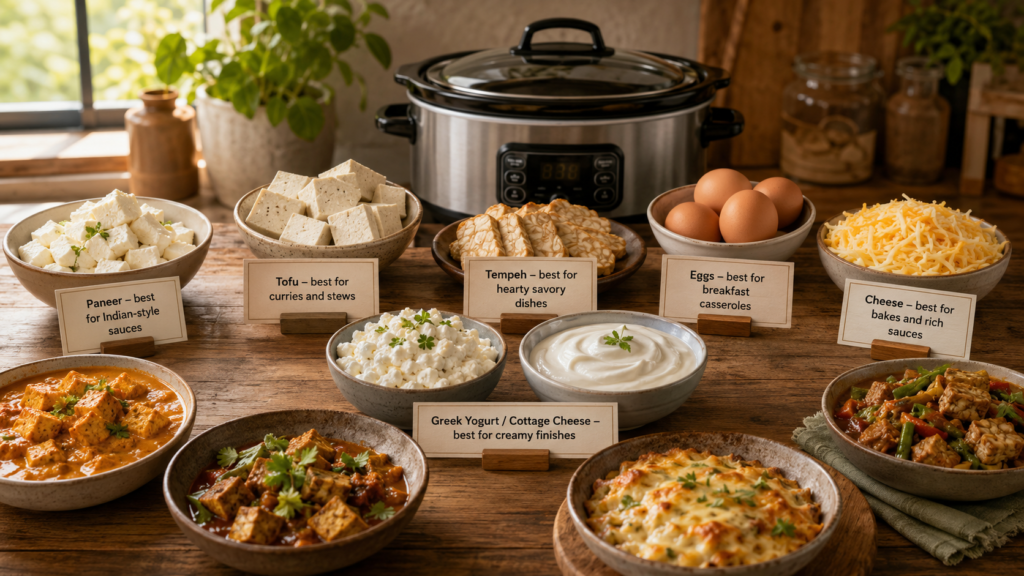
The highest-protein ingredient is not automatically the best slow-cooker choice. Seitan can provide substantial protein but contains gluten. Cottage cheese may work well in an egg casserole but not in a vegan curry. Tofu is highly adaptable, although its texture depends on pressing, cube size and cooking duration.
Compare protein sources using the exact product label whenever possible because tofu firmness, seitan recipes and plant-based mince formulations vary considerably.
Use this decision framework:
- Extra-firm tofu: Best for curry, chili, Tuscan sauce and vegetable stew
- Tempeh: Best for coconut curry, cabbage soup and strongly seasoned sauces
- Eggs: Best for quiche, breakfast casserole and vegetable bakes
- Cottage cheese: Best for egg casseroles and lasagna fillings
- Paneer: Best for Indian-style curries and tomato sauces
- Seitan: Best for stroganoff and hearty stew; unsuitable for gluten-free diets
- Greek yogurt: Best stirred into finished sauces; avoid prolonged high heat
- Hemp hearts: Best as a topping or supporting ingredient rather than the only protein
- Plant-based mince: Best for chili and cabbage soup when starch and sugar are controlled
- Lupini products: Useful where available, but international accessibility varies
For a more complete dinner, avoid relying only on cheese sprinkled over vegetables. Identify the main protein in the recipe title, comparison table and recipe card.
Which Recipes Are Best for Meal Prep and Freezing?
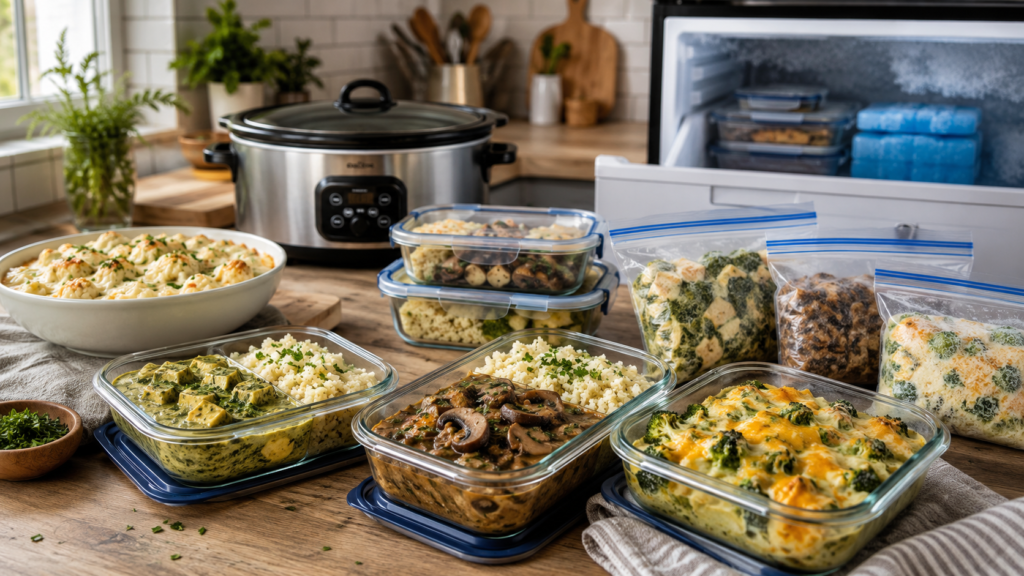
The best meal-prep recipes have stable sauces, vegetables that tolerate reheating and clearly defined serving sizes. Chili, tomato-based casseroles, cabbage soup, tofu curry and vegetable stew generally store more predictably than delicate egg dishes or cream-heavy soups.
Before storing a meal, divide it into shallow containers so it cools efficiently. Do not leave cooked food at room temperature for extended periods. USDA food-safety guidance emphasizes cleaning, safe cooking and prompt chilling, while perishable foods should not remain within unsafe temperature ranges for prolonged periods.
Recipes that usually freeze well include:
- Vegetarian keto chili
- Cauliflower tikka masala
- Tempeh coconut curry
- Cabbage roll soup
- Vegan vegetable stew
- Zucchini and eggplant lasagna
- Eggplant Parmesan casserole
- Creamy Tuscan tofu without delicate garnish
Recipes generally better refrigerated include:
- Crustless egg casserole
- Three-cheese spaghetti squash
- Broccoli cheddar soup
- Mushroom stroganoff
- Spinach artichoke casserole
- Dishes topped with avocado or fresh herbs
For best quality, freeze garnishes separately. Add yogurt, avocado, fresh herbs, nuts and seeds after reheating. Cream-based dishes may separate slightly after freezing, but gentle reheating and careful stirring can often restore an acceptable texture.
Thaw frozen meals in the refrigerator rather than on the counter. University of Minnesota Extension identifies refrigerator thawing as the safest method because it keeps the food cold during the process.
Label every container with the recipe name, portion size and freezing date. Recalculate nutrition when the recipe yield changes because a larger or smaller serving can materially alter its carbohydrate and protein values.
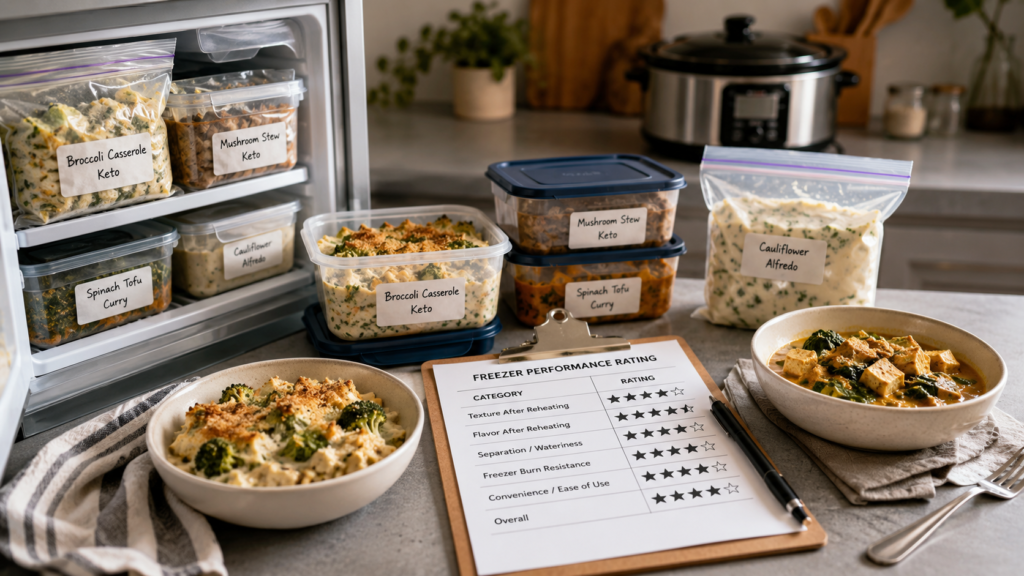
How Should Freezer Performance Be Rated?
A recipe should not be called freezer-friendly solely because it can be frozen. The useful question is whether it returns to an acceptable texture after thawing and reheating. Cream may separate, zucchini may release additional moisture and egg casseroles may become rubbery even when the food remains safe to eat.
Test one full serving after refrigeration and one after freezing. Reheat both using the same method, then compare sauce consistency, vegetable texture and protein structure with the freshly cooked meal.
Use these ratings:
- Strong: Reheats with little noticeable texture loss
- Moderate: Flavor remains good but the sauce or vegetables change slightly
- Limited: Safe to store, but quality drops enough that refrigeration is preferred
- Not recommended: Separation, graininess or water release significantly harms the dish
Record practical details:
- Whether the meal was frozen with dairy already added
- Whether garnishes were removed
- How long the meal thawed in the refrigerator
- Whether excess liquid appeared
- Whether gentle stirring restored the sauce
- Whether additional cheese, cream or thickener was needed
- Whether vegetables became softer after reheating
Add the final rating to each recipe card. Keep avocado, herbs, nuts, seeds, yogurt and crisp toppings separate until serving.
What Common Mistakes Ruin Vegetarian Keto Crockpot Meals?
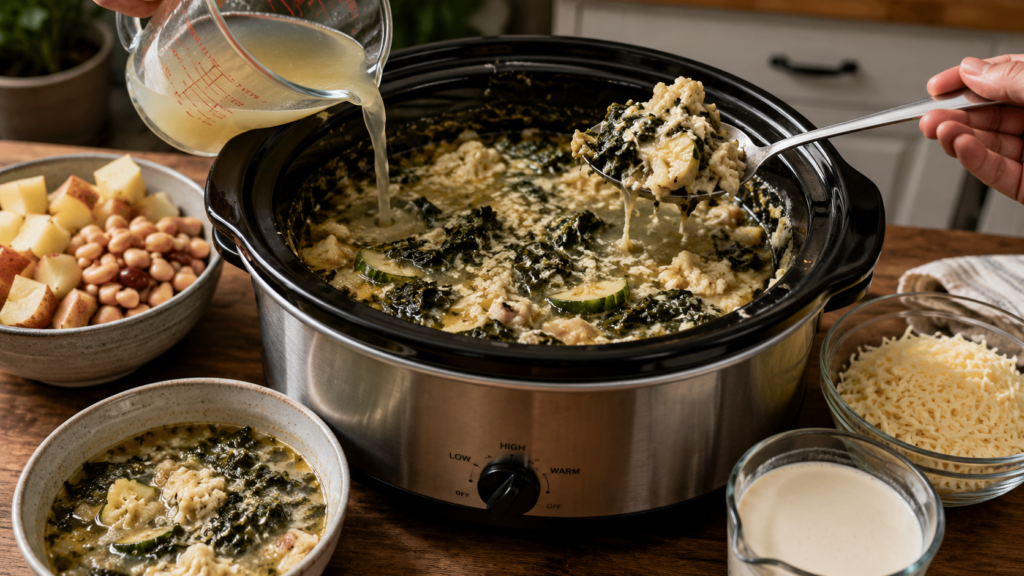
The most common mistake is assuming that a recipe is keto simply because it contains no meat or added sugar. Carbohydrates can accumulate through vegetables, sauces, nuts, dairy products and processed meat substitutes, while poor slow-cooker technique can leave an otherwise suitable meal thin, bland or overcooked.
Another mistake is treating vegetables as the only substantial component. Cauliflower, zucchini and mushrooms create volume but may not provide enough protein by themselves. A dinner should include tofu, tempeh, eggs, dairy, seitan or another clearly identified protein source.
Texture mistakes are equally damaging. Adding zucchini at the beginning of an eight-hour cycle can turn it soft and watery. Cooking cheese or yogurt for the entire duration can produce a separated sauce. Adding frozen vegetables without draining them can dilute the seasonings.
Avoid these failures:
- Using beans or lentils without calculating their carbohydrates
- Adding excessive onion, tomato sauce or cashew cream
- Selecting sweetened coconut milk or bottled sauce
- Assuming every plant-based meat substitute is keto-friendly
- Using too much vegetable stock
- Adding spinach, zucchini and dairy too early
- Cutting tofu into pieces too small to remain intact
- Filling the cooker too deeply
- Removing the lid repeatedly
- Using flour or cornstarch automatically
- Publishing nutrition without a defined yield
- Calling a vegetable side dish a high-protein dinner
- Reheating cream-based meals too aggressively
Slow-cooker safety also matters. Start with clean equipment, keep perishable ingredients refrigerated until preparation, and follow the appliance manufacturer’s instructions. USDA recommends thawing frozen ingredients safely rather than relying on the slow cooker to bring large frozen items gradually through unsafe temperatures.
A reliable recipe controls nutrition, flavor, texture and food handling simultaneously. Ignoring any one of those areas weakens the final result.
How Do You Choose the Right Recipe for Your Diet?
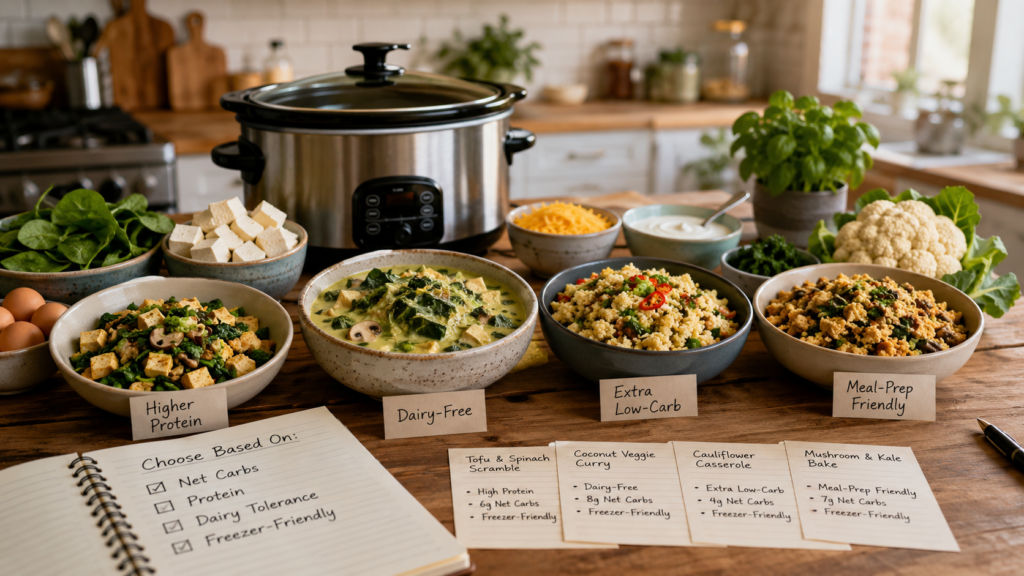
Choose a recipe by checking four factors: dietary restrictions, protein source, estimated carbohydrates and cooking behavior. A recipe that fits one vegetarian keto reader may not work for another because dairy, eggs, soy, gluten and nuts affect both suitability and nutrition.
Begin with the protein source. Tofu and tempeh suit many vegan recipes but are unsuitable for someone avoiding soy. Seitan works well in stew and stroganoff but contains gluten. Eggs and dairy simplify low-carb vegetarian cooking but do not meet vegan requirements.
Next, consider the type of meal. A thick casserole or chili usually works better for freezing, while a delicate egg dish is better for a fresh breakfast. Curries and soups are useful for batch cooking, but their liquid must be controlled carefully.
Use this decision guide:
- For vegan meals: choose tofu curry, tempeh curry, vegetable stew or buffalo cauliflower with vegan fat
- For higher protein: choose tofu chili, tempeh curry, seitan stroganoff or crustless broccoli quiche
- For freezer meals: choose chili, cabbage soup, lasagna or eggplant casserole
- For comfort food: choose broccoli cheddar soup, mushroom stroganoff or spinach artichoke casserole
- For dairy-free meals: choose coconut curry, tomato-based chili or vegan vegetable stew
- For soy-free meals: choose egg casserole, paneer curry, cheese soup or eggplant Parmesan
- For family dinners: choose a low-carb base and serve rice, bread or pasta separately to non-keto diners
For a balanced weekly rotation, avoid preparing seven cheese-heavy meals or seven tofu dishes. Alternate protein sources, vegetable families and sauce styles. This creates more variety while reinforcing the practical connection between ketoslowcookerrecipes.com, vegetarian keto eating and dependable slow-cooker meal planning.
How Can International Readers Adapt the Recipes?
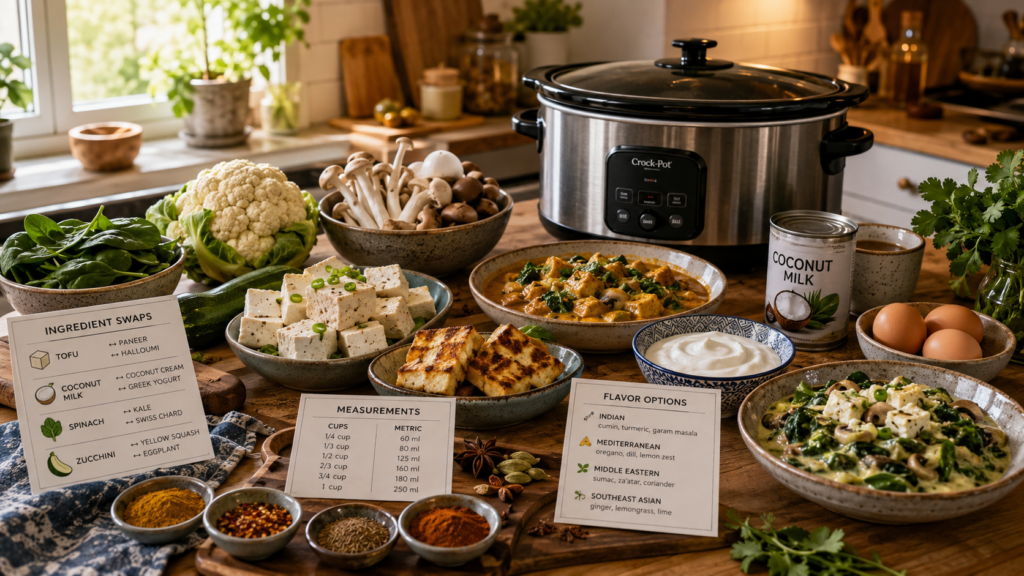
Ingredient names, package sizes and nutrition labels vary across countries. Zucchini may be sold as courgette, eggplant as aubergine and heavy cream as double cream or whipping cream. Tomato passata may replace strained tomatoes, while cottage cheese, paneer, halloumi and seitan can differ greatly in salt, texture and availability.
Use substitutions according to cooking function rather than name alone. Halloumi and paneer are both firm cheeses, but halloumi is saltier and may not soften into a curry in the same way. Coconut beverage is much thinner than canned coconut milk and should not be substituted without reducing other liquid.
Helpful international notes include:
- Zucchini: courgette
- Eggplant: aubergine
- Heavy cream: double cream or high-fat whipping cream
- Tomato passata: strained tomatoes or blended canned tomatoes
- Crock-Pot: a brand name commonly used to mean slow cooker
- Bell pepper: capsicum or sweet pepper
- Cilantro: fresh coriander leaves
- Scallions: spring onions or green onions
- Shredded cheese: grated cheese
- Canned coconut milk: not coconut drinking beverage
Publish both metric and US measurements on complete recipe pages. Where a specialized ingredient such as lupini, seitan or low-carb plant mince is unavailable, provide a tofu, tempeh, egg or dairy alternative.
Are Slow Cooker Vegetarian Keto Recipes Healthy?
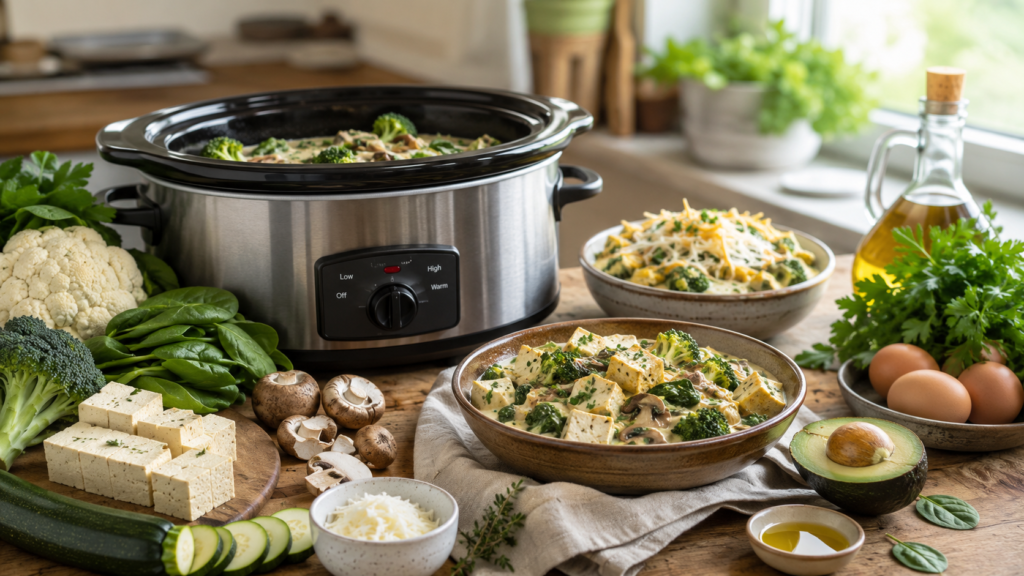
Slow cooker vegetarian keto recipes can support a well-planned eating pattern, but their nutritional quality depends on more than carbohydrate restriction. A dish dominated by cheese, cream and butter is nutritionally different from one built around tofu, olive oil, cauliflower, mushrooms, seeds and leafy vegetables.
A useful recipe should provide a genuine protein source, vegetable variety and appropriate portions. It should also avoid presenting ketosis as automatically beneficial for every person. Research defines ketogenic diets in several ways, and responses vary according to health status, medication, energy intake and adherence.
Improve nutritional variety by:
- Rotating tofu, tempeh, eggs, dairy and other proteins
- Using olive oil, avocado, nuts and seeds regularly
- Including leafy greens and cruciferous vegetables
- Controlling highly processed vegetarian substitutes
- Watching sodium in stock, cheese and sauces
- Choosing unsweetened products
- Defining realistic serving sizes
- Planning vitamin B12 sources, especially for vegans
- Discussing restrictive diets with a qualified professional when appropriate
A ketogenic diet may not be suitable for everyone. People who are pregnant or breastfeeding, have a history of disordered eating, have certain kidney, liver or pancreatic conditions, or use glucose-lowering medication should seek individualized medical advice before making a major dietary change. Medication interactions and the risk of low blood glucose can be particularly relevant for some people with diabetes.
The purpose of this collection is recipe discovery and meal-planning support, not medical treatment. Readers should use the recipes as flexible starting points and calculate nutrition with their actual ingredients.
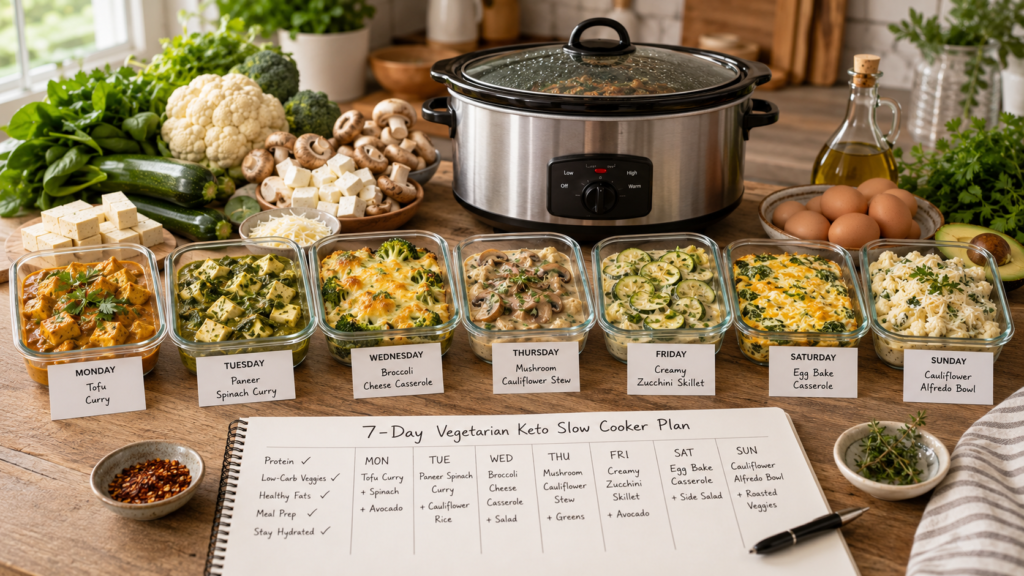
What Is the Best Seven-Day Vegetarian Keto Slow Cooker Plan?
A useful weekly plan alternates protein sources and cooking styles so that vegetarian keto eating does not become a repetitive sequence of cheese casseroles. It should also reuse selected ingredients to reduce waste without repeating the same finished meal.
Prepare cauliflower, mushrooms, spinach, zucchini, tofu and herbs in advance. These ingredients can appear in several recipes while producing distinctly different flavors. For example, cauliflower can become Indian curry, cheese soup or buffalo-style bites, while tofu can be used in chili, Thai curry and Tuscan sauce.
A practical seven-day rotation is:
- Monday: Cauliflower tikka masala with tofu and spinach
- Tuesday: Mushroom stroganoff with seitan or firm tofu
- Wednesday: Vegetarian keto chili with avocado topping
- Thursday: Broccoli cheddar soup with pumpkin seeds
- Friday: Thai peanut tofu curry with sautéed greens
- Saturday: Zucchini and eggplant lasagna
- Sunday: Crustless broccoli quiche with a side salad
Prepare one or two slow-cooker meals in larger quantities and refrigerate or freeze additional portions. Add delicate toppings only when serving. Non-keto family members can eat the same meal with rice, bread, tortillas or pasta served separately.
Before starting the week:
- Check the carbohydrate content of sauces and meat substitutes
- Choose at least three different protein sources
- Wash and portion firm vegetables
- Drain and press tofu
- Prepare spice mixtures
- Label storage containers
- Keep fresh garnishes separate
- Calculate servings before entering nutrition data
This rotation creates variety in flavor, texture and protein while maintaining one low-carb vegetarian base for the household.
What Should You Buy for the Seven-Day Plan?
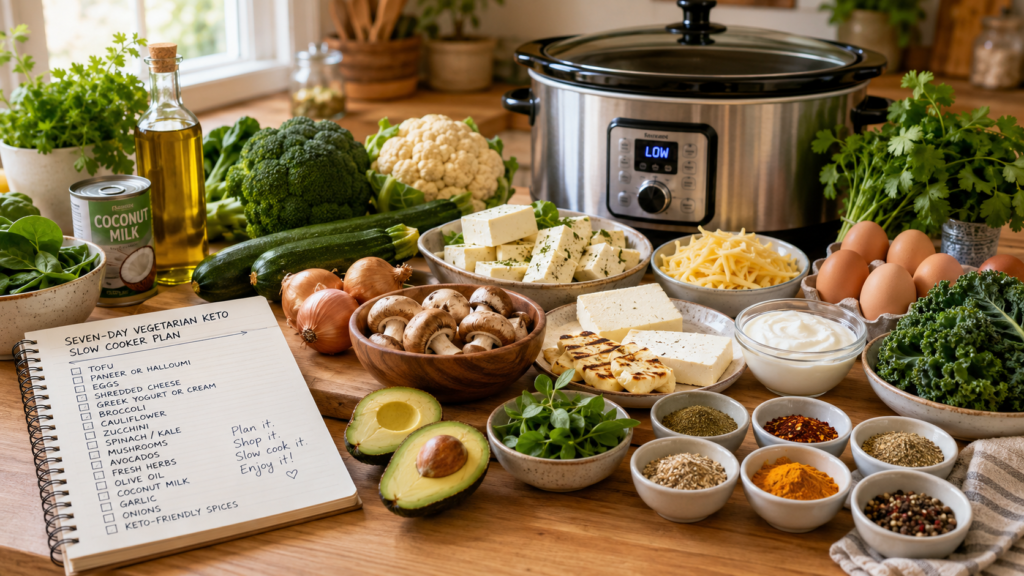
A consolidated shopping list reduces waste by reusing versatile ingredients across several meals. Cauliflower can support tikka masala, broccoli soup thickening and low-carb rice. Spinach can finish curry, chili and quiche, while tofu can be divided between Indian, Thai and tomato-based recipes.
The exact quantities should be adjusted to the number of servings in the finalized recipes. Use the following as a category-based planning guide rather than a fixed nutritional prescription.
Fresh produce
- Cauliflower
- Broccoli
- Mushrooms
- Zucchini or courgettes
- Eggplant or aubergine
- Spinach or kale
- Cabbage
- Bell peppers
- Onions, garlic and ginger
- Fresh herbs, lemons and avocados
Vegetarian proteins
- Extra-firm tofu
- Tempeh
- Eggs
- Cottage cheese or ricotta
- Cheddar and mozzarella
- Seitan or low-carb vegetarian mince
Pantry and refrigerated items
- Unsweetened canned coconut milk
- Low-sugar tomato passata or canned tomatoes
- Vegetable stock
- Natural peanut butter
- Olive or avocado oil
- Curry paste and dried spices
- Cream cheese or heavy cream
- Olives, artichoke hearts, seeds and nuts
Preparation tasks:
- Press and portion tofu
- Wash and cut firm vegetables
- Brown mushrooms for early-week recipes
- Mix spice blends
- Grate cheese
- Label containers by recipe
- Keep fresh garnishes separat
What Will Make This Guide More Reliable Over Time?
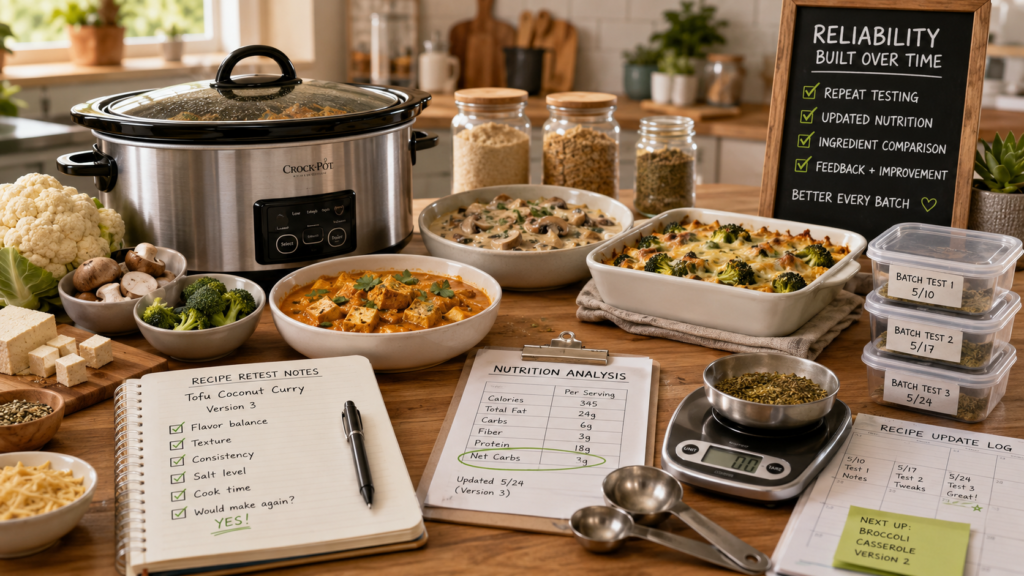
This guide should be updated as complete recipe pages are developed and tested. Each supporting recipe should send verified cooking data back to the roundup, including the cooker size, high and low settings, serving yield, calculated nutrition, storage quality and any texture problems found during testing.
A useful content refresh should do more than change the publication date. It should improve the evidence behind the recommendations.
Update the guide when:
- A recipe completes its first physical test
- A cooking time or liquid quantity changes
- A new vegan or allergen-friendly variation is confirmed
- Nutrition values are recalculated
- A recipe is tested in a second cooker capacity
- Freeze-and-reheat observations become available
- A product formulation changes significantly
- A new supporting recipe page is published
- Reader feedback reveals a repeatable cooking problem
Maintain a visible “last reviewed” date and explain major changes where appropriate. This creates a stability signal for readers and search systems while preventing outdated nutrition or cooking instructions from remaining on the page.
The long-term goal is for every recipe concept in this roundup to become a complete, internally linked recipe with transparent methodology rather than remaining a one-sentence suggestio
Final Thoughts
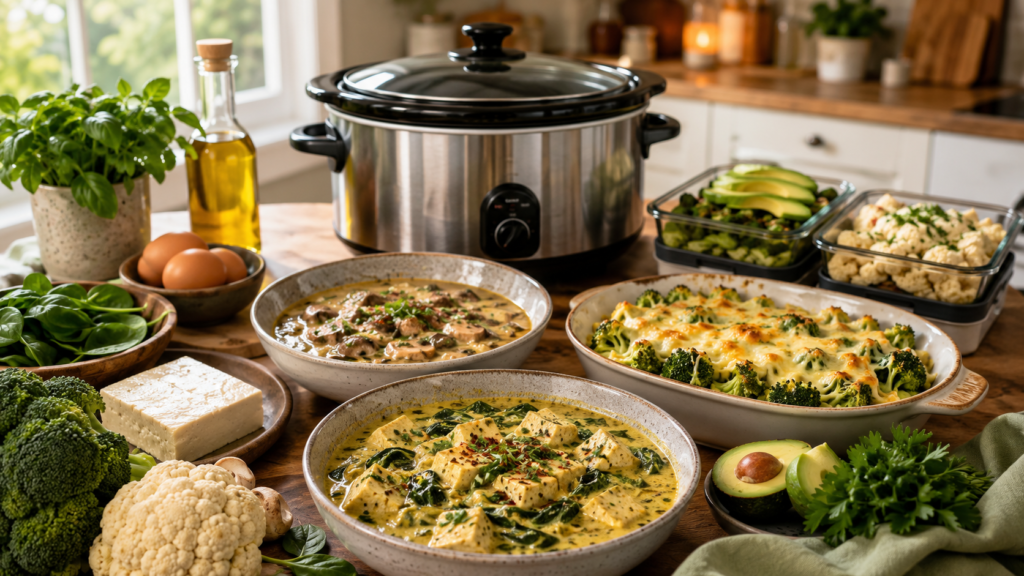
The best slow cooker vegetarian keto recipes do more than remove meat and starch. They use a defined vegetarian protein, control hidden carbohydrates, manage vegetable moisture and add delicate ingredients at the correct time.
Start with cauliflower tikka masala, vegetarian chili or tofu coconut curry if you want reliable meal-prep options. Choose broccoli cheddar soup, mushroom stroganoff or zucchini lasagna for comfort food. For a vegan rotation, rely on tofu, tempeh, coconut sauces, seeds and varied low-carb vegetables rather than vegetables alone.
Frequently Asked Questions
Can vegetarians follow a keto diet?
Yes. A vegetarian keto diet can use eggs, dairy, tofu, tempeh, seitan, nuts, seeds and low-carb vegetables. It requires more planning than a conventional keto diet because many common vegetarian proteins, including beans and lentils, also contribute substantial carbohydrates.
Can tofu be placed directly in a slow cooker?
Firm or extra-firm tofu can be added directly after pressing and cutting it into large cubes. Browning it first creates a firmer exterior and deeper flavor. Silken tofu should normally be added near the end or blended into a sauce.
Are beans allowed in vegetarian keto recipes?
Small portions may fit some individual carbohydrate targets, but most bean-heavy soups and chili recipes are not suitable for strict keto plans. Calculate the complete recipe and portion rather than treating all beans as automatically included or excluded.
How do you thicken a vegetarian keto slow-cooker meal?
Use cream cheese, grated cheese, puréed cauliflower, ground chia, ground flax or a very small quantity of xanthan gum. You can also remove some cooking liquid and reduce it separately before returning it to the meal.
Why does zucchini become watery in a Crockpot?
Zucchini contains considerable moisture and softens quickly. Salt and drain it before cooking, use thick slices and add it during the later cooking stage rather than at the beginning of a long cycle.
Can vegetarian keto slow-cooker meals be frozen?
Chili, curry, cabbage soup, lasagna and vegetable stew generally freeze well. Egg dishes, cream soups and cheese-heavy squash dishes are often better refrigerated because their texture can change after thawing.
What can replace meat in keto chili?
Firm tofu crumble, tempeh, chopped mushrooms, seitan or a low-carb vegetarian mince can replace meat. Combining mushrooms with another protein often produces the best balance of texture and substance.
Are plant-based meat substitutes keto-friendly?
Some are, but many contain starch, flour, sugar or high-carbohydrate binders. Check the nutrition label and ingredient list for the exact product rather than relying on words such as “plant-based,” “vegan” or “high protein.”
What vegetables are best for long slow cooking?
Cauliflower, cabbage, eggplant, peppers, broccoli stems and green beans hold their structure reasonably well. Spinach, zucchini, fresh herbs and tender broccoli florets should be added later.
What size slow cooker is best?
A 4- to 6-quart slow cooker suits many family recipes. The cooker should generally be filled according to the manufacturer’s instructions; a severely underfilled or overfilled appliance can affect cooking time, moisture and texture.
By combining clear nutrition methodology with realistic slow-cooker techniques, ketoslowcookerrecipes.com can provide a more useful resource than a generic recipe collection.

Humera is the recipe creator behind Keto Slow Cooker Recipes. She focuses on simple, practical keto and low-carb slow cooker meals made with everyday ingredients. Her recipes are designed to help home cooks prepare satisfying meals with straightforward instructions and less hands-on cooking.